
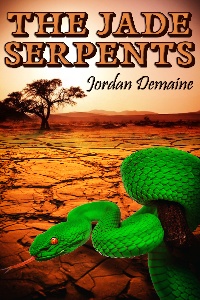
At the height of the Mexican Revolution, Luís is working at his family cantina in the sleepy town of Santa Rosa de las Cruces, in Chihuahua. One rainy night, a stranger comes to town with a story he finds hard to believe: that the story of the jade serpents, ancient treasures he has been hearing about since he was a child, is more than a story. That man, Oxford archaeologist Peregrine Roscoe, believes he can find the serpents, and he asks Luís to help.
At first Luís is reluctant to leave home. But the resurgence of his old enemy, local gang leader Diego Morales, and news of a rival archaeologist in the area spurs him to act. What follows is an adventure he never expected, but will they find what they're looking for? And what cost will they pay to get it?
By the morning, the rain had stopped, although water still dripped from the walls of homes and businesses alike, and great puddles in the street reflected the gray sky above.
Luís hadn’t slept much. His mind kept returning to the stranger. Eventually, he gave up, dressed, and went to tidy the cantina.
It had been in Luís’s family since it opened nearly fifty years ago, first run by his great-grandparents and then by his grandmother. It was his inheritance. Luís understood that. But understanding something and wanting it wasn’t always the same. Some days, he felt the difference more clearly than others.
As Luís rinsed out glasses, Pedro Vidal loped down the stairs and left with a cheerful, unembarrassed wave. As Luís was pouring water into a bucket to wipe down the floor, he heard a second set of footsteps on the stairs.
Roscoe came down slowly, one hand on the rail. His hair was as pale as Luís had expected. He wore the same clothes as the night before. They looked creased but mostly dry.
“Good morning,” Roscoe’s accent seemed more pronounced now. Luís could easily tell the difference between his voice and John’s.
“Would you like a cup of coffee?” Luís offered.
Roscoe’s face lit up with a pleasure that seemed out of proportion to the question. “You are continuing to save my life, Señor Garcia.”
Luís set the pot on the stove. When the water had boiled, he poured two cups, slid one across the bar, and watched as Roscoe wrapped both hands around it.
For a moment, they drank in silence.
“I have a rather stupid question,” Roscoe said at last. “Where am I? It was so dark last night, and I was in something of a state, as you no doubt remember.”
Luís looked at him over the rim of his cup. “Santa Rita de las Cruces. In northern Chihuahua,” he added, not sure just how lost Roscoe was. “It’s not much of a town.”
Roscoe met his gaze. His eyes were an astonishing blue. “Perhaps not,” Roscoe replied, “but it seems like it’s exactly where I need to be.”
Luís set his cup down. Briskly, he said, “You should leave soon. Nothing stays a secret around here. It won’t take long for Diego Morales to know where you are.”
Roscoe looked around as if he hadn’t spoken, taking in the cantina with its six scarred tables with their mismatched chairs, the blue woven blanket hanging on the wall, and the bottles on shelves behind the bar. “This is a lovely place,” he said. “Very cozy. I quite like it.”
“Thank you.” Luís tried again. “But you would be much better off in Texas. The farrier will sell you a horse.” It would be a flea-bitten old nag, and as a foreigner, Roscoe would pay well over the odds for it, but it would get him over the river.
Rather than ask where the farrier was, or any other sensible questions, Roscoe said, “Your English is very good.”
Luís didn’t want to feel flattered by that. “I learned from an American friend.” Reducing John to a friend always seemed insulting, but there was no other option.
“He taught you well.”
Luís wasn’t sure what to say to that, so he said nothing. After a moment, Roscoe glanced over his shoulder, then leaned forward. “Can I show you something?”
Luís hesitated, but Roscoe was already reaching into the inside pocket of his jacket.
He produced an oilcloth bag. Reaching inside, he pulled out a notebook. It was thick and leather-bound, although fairly small in size. The pages were roughly cut, and when Roscoe opened it, Luís saw notes in elegant handwriting and small, sometimes colorful pictures. Roscoe flipped through the book, then turned it to face Luís.
“This is why I was so fascinated by your tattoo.”
The drawing in the middle of the page matched Luís’s serpents almost identically, although it was far more detailed, and colored a rich green. “As I said, I’m an archaeologist. That means I’m someone who studies the past.”
“I know what it means,” Luís replied, examining the page.
“Of course. My apologies.”
Nobody else in the village would know what the word meant, in English or in Spanish. Luís only knew because John had brought newspapers with him occasionally, and they’d read together about the discoveries at the pyramids in Egypt. “Where did you see this symbol?”
Roscoe smiled. “I was about to ask you the same thing.”